



Designing tomorrow’s learning environments
Overview
Campus of the Future (COTF) engages students and the campus community in a series of conversations about the future of education at the University of Michigan. Organized around seven major dimensions, COTF links events, workshops, design jams, curricular and co-curricular learning opportunities as well as research symposia and special showcases of student-led projects, ideas, and reflections.
At every turn we want to experiment with what it means to design with—not just for—students: blending curiosity, technical skill, and community insight to envision the next generation of educational experiences.
Campus of the Future Student Idea Showcase
In partnership with members of the university innovation and entrepreneurship ecosystem, the Campus of the Future Student Idea Showcase will offer opportunities for students and student-teams to explore questions and provide insight into the student experience within the Campus of the Future framework, culminating in presenting to University leadership -- including President Grasso & Provost McCauley -- at a COTF Showcase at the end of Winter 2026. The Showcase will highlight a student-led vision for a campus of the future. All finalists selected to present will receive a monetary award for each team member.
Building Capacity
To build the capacity of our community to grapple with challenges of the present and possibilities for the future we're organizing a series of learning opportunities across seven dimensions. In each dimension, we'll offer avenues for deeper engagement, with access to speakers and panels, research briefs, and problem statements composed by campus experts to inspire informed problem solving and reflection.
Dimension 1: The History of the Future at U-M
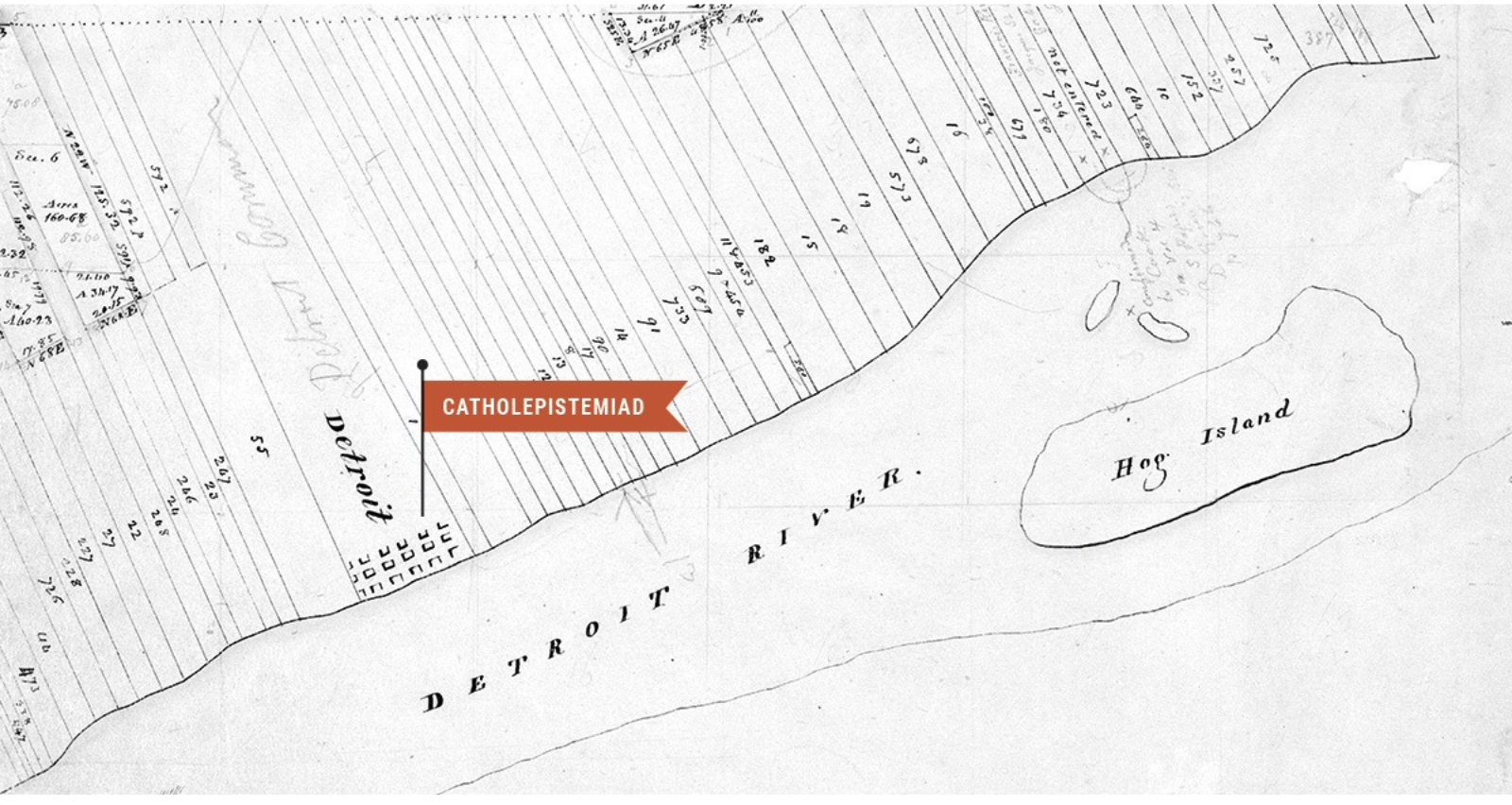
Imagining the future is a Michigan tradition. In 1817 near the banks of the Detroit River an audacious vision for the Catholepistemiad was created in the university's infancy. Today we continue to look back to our history for inspiration.
The Inclusive History Project's research-oriented 1817 Project: Land, Culture, Memory, and Repair critically examines the early history of the university and institutional narratives surrounding a "gift" of land received from Anishinaabe communities in exchange for promises to educate their children. This complex history will be explored in Living with Treaties: The 1817 Project, the University of Michigan, and the Western Expansion of the United States Conference, April 9-11, 2026.
Resources for understanding U-M's history are also available from the Bentley Historical Library, the Department of History's Michigan in the World public history program, the Inclusive History Project as well as in the CRLT Player's unique performance and discussion opportunity How Do We Begin: A Historical Reckoning with Anti-Black Racism at U-M.
Related Links:
- Bentley Historical Library
- Michigan in the World
- Inclusive History Project
- CRLT Players - How Do We Begin
Dimension 2: The Physical Campus & Place(s) of Education
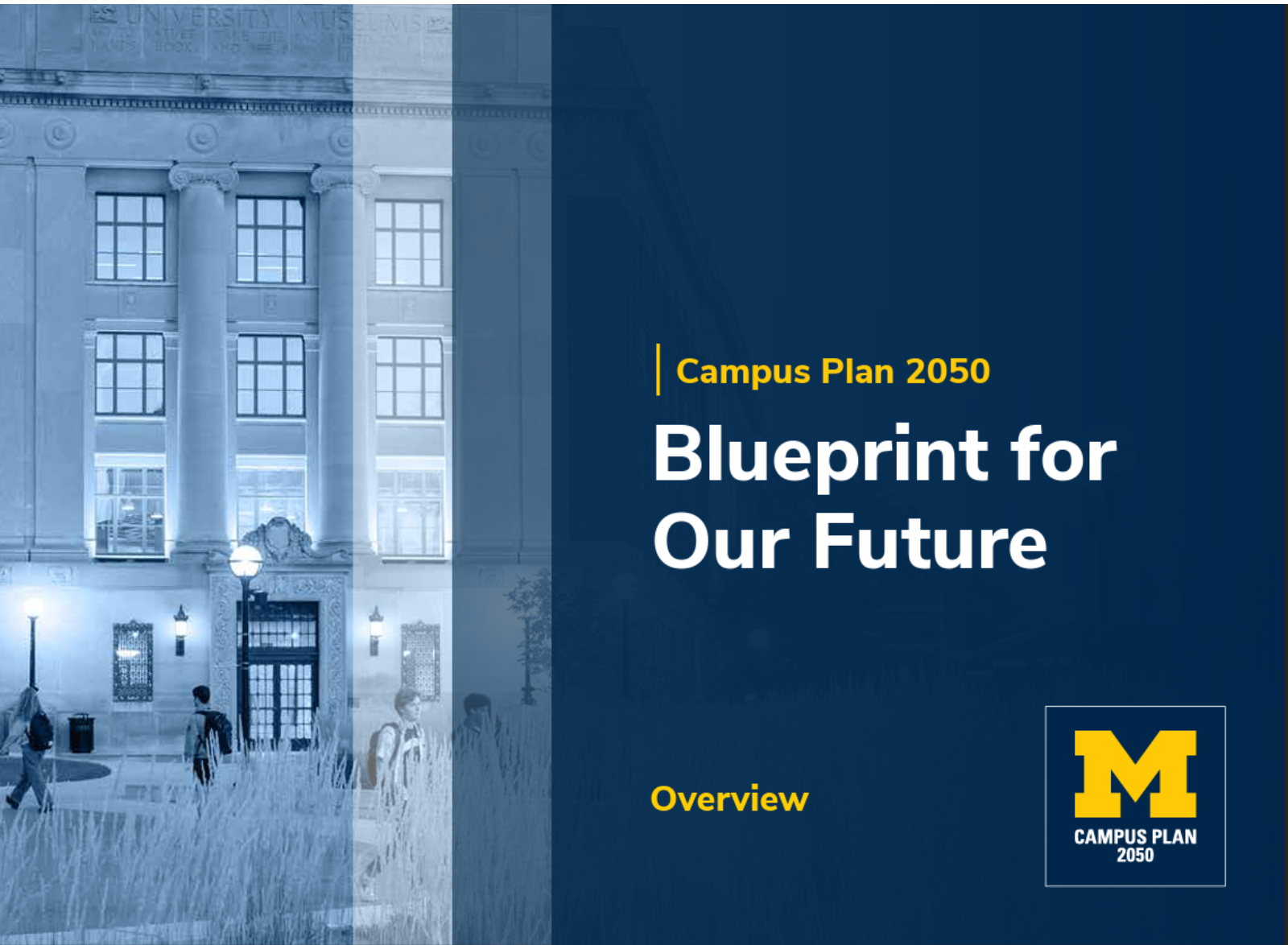
Campus Plan 2050, designed to respond to the ever-changing needs of a growing academic community for the next 25 years, is one way to think about the physical and constructed environment of the university and spaces for education and innovation.
But the Ann Arbor campus is not the only place where a Michigan education happens. There are also campuses in Flint, Dearborn, and Detroit. Our students take classes and do research at the BioStation, Camp Davis, the Matthaei Botanical Gardens, on the Great Lakes, and beyond. This section of COTF allows us to think together about how and why place and space matter across diverse residential and non-residential environments.
Related Links:
Dimension 3: Sustaining the Campus of the Future
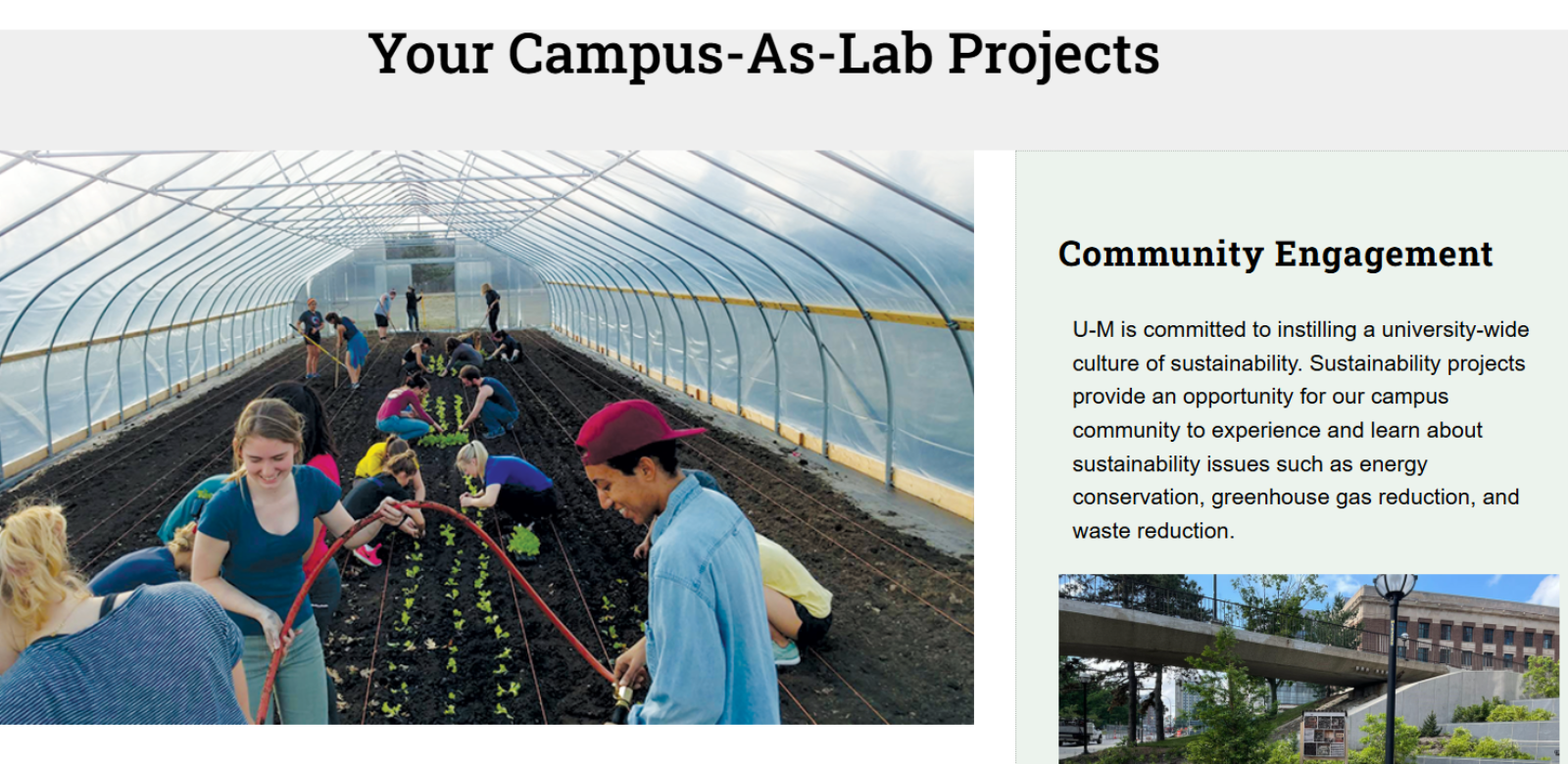
Whatever our campus of the future looks like, it needs to be sustainable. Turning the university into a place for testing bold ideas and new projects, students learn by designing, planning, and implementing solutions to significant issues such as food access, waste, and energy use.
By blending classroom knowledge with real-world practice, students prepare to tackle today's and tomorrow's toughest climate and sustainability challenges. We're proud to partner across schools, colleges, and units to highlight approaches that turn our campuses into living labs for experimentation and reflection.
Related Links:
- Course Search | Graham Sustainability Institute
- Featured LCE Course: ENVIRON 391 Sustainability & the Campus | Graham Sustainability Institute
- Campus-As-Lab Sustainability Projects
- Michigan Community Climate Action Fellowship
- Student Life Sustainability 2024-2025 Annual Report
- Michigan Sustainability Community
Dimension 4: High Impact Practices & The Future of Student Success
High-impact practices (HIPs) have a special role in contemporary education. Practices such as internships, study abroad, community-based projects, research, writing-intensive courses, and capstone experiences have been proven to boost student engagement, deepen learning, and increase retention.
They require students to invest significant time and effort in complex, authentic tasks that involve active, collaborative, and hands-on learning. Key features include high expectations, meaningful reflection, frequent feedback, and real-world application.
For the past thirty years undergraduate schools and colleges have invested heavily in HIPs. They have become prominent fixtures in student success efforts that seek to close equity and opportunity gaps and ensure equal access to high-quality learning experiences for all students. Where might institutions such as Michigan, whose Student Success Initiative was launched last year, go in the future? Join us for conversations that reflect on the past and chart a course for the future.
Related Links:
Dimension 5: Future of Graduate Education
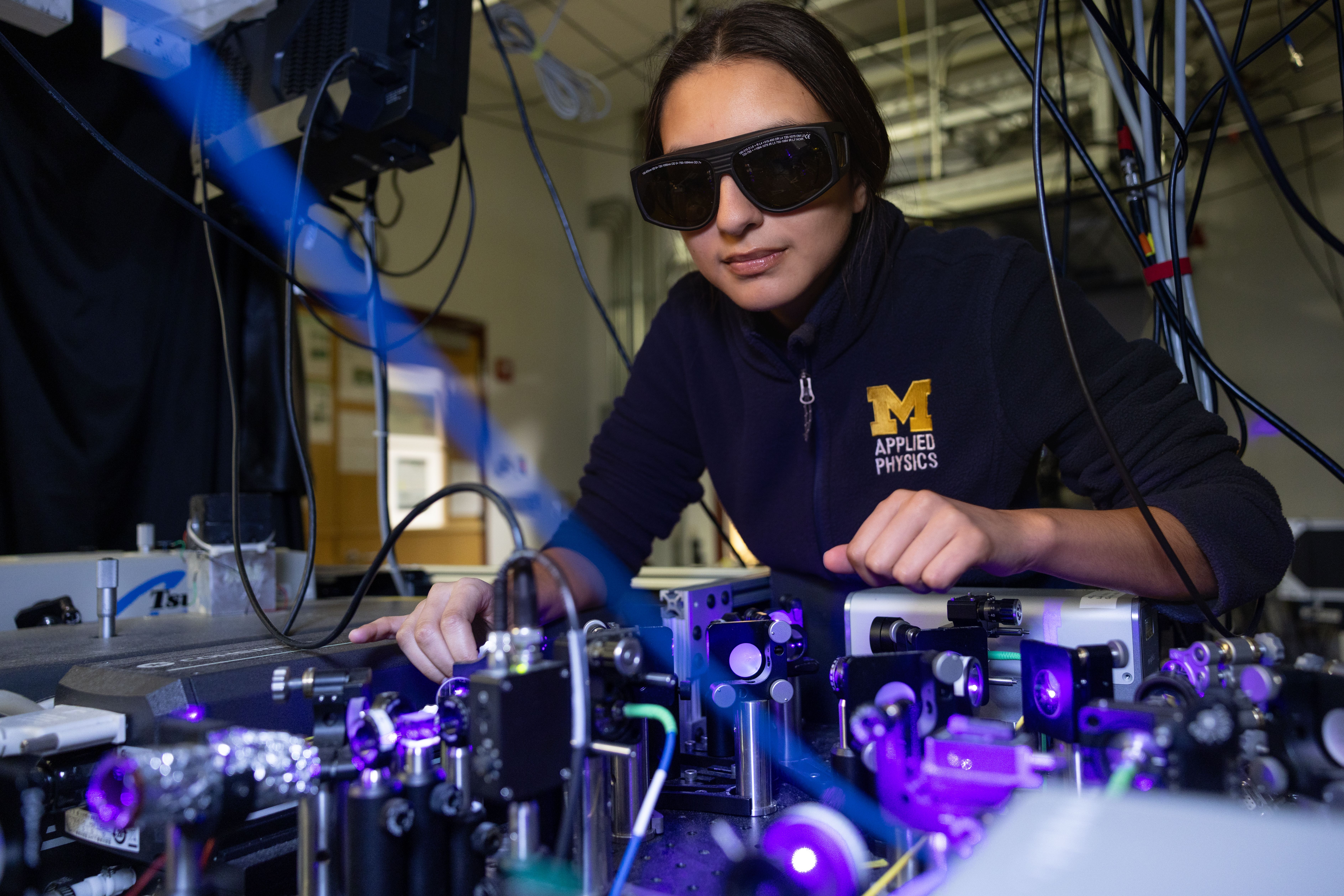
As the Rackham Graduate School prepares for its 150th anniversary (2026-2027), they’ll be launching a series of events, activities and public forums on the future of graduate education on our campuses, starting with Rackham’s Student AI Working Groups. In partnership with other campus efforts, Rackham Graduate School launched the Rackham Student AI Working Groups program on November 3. Over the course of the winter 2026 term, Rackham students will explore and contribute to the dynamic and quickly evolving use of AI in graduate education through collaborative learning in interdisciplinary working groups. Rackham Student AI working groups will present their research findings at a research symposium scheduled for Monday, May 4, 2026.

Dimension 6: Advanced Technology & Campus of the Future
Is the future already here? What are the impacts of Generative AI and other advanced technologies on the teaching and learning mission of the university and how should we begin to plan for what the future might bring?
The Center for Academic Innovation is designing that future in the present through Michigan Online, curricular innovations, tools for student success and equity, and educational research and analytics. We'll be partnering with CAI and other units on campus to explore different visions of how we're crafting the future of learning through advanced technology.
Related Links:
Key Date:
- AI & the Future of Learning Summit (March 17, 2026)
Dimension 7: The Arts & Wellness in Forging the Future
Being an Okanagan Charter Campus charges us to envision a future in which U-M embeds health into all aspects of campus culture and communities beyond. ArtsRx is helping to propel a broad social prescribing effort at U-M. Social prescribing is a tool that helps health and social care providers connect people with community-based activities like art, movement, time in nature, or volunteering. It’s about improving well-being through creative, meaningful experiences that make a real difference in people’s lives.
ArtsRx is a campus partnership powered by the Arts Initiative with University Health & Counseling, Wolverine Wellness, Student Life, the School of Music, Theatre & Dance, Stamps School of Art & Design, UMMA, UMS, CHHASSEM, MHealthy, Ginsberg, and M|Recreation. Together, they're building on decades of research on how arts experiences can improve mental health and well-being. Where might they go in the future?
Related Links:
Upcoming Events
Join design showcases, workshops, and competition events throughout the year.
Join us for the documentary screening and post-film discussion of "Things We Imagined: Future and Academic Life." The event will be moderated by Dr. Demetri Morgan featuring Q&A with Dr. Charles H.F. Davis III and Dr. Candace N. Hall.
02/05/2026
5:30 PM - 7:30 PM
Marsal Building, Prechter Lab
Come enjoy a sweet treat and make new friends while testing out U-M's new conversation game, The Pluralism Playdeck. The Pluralism Playdeck is a low-key scaffolded card game designed to allow university students to practice the soft skills they need to engage in compassionate and honest conversations about hot-button issues across ideological and demographic differences. You'll learn about yourself. You'll learn about others. You'll develop a skill set that will serve you well in both social and professional settings.
02/26/2026
1:00 PM - 2:30 PM
LSA Building, Room 1040
What if a set of photos could completely transform how you understand your purpose, the experiences of others, and the value of humanity? With over 5 billion pictures taken globally every day, Photovoice uses this powerful medium to foster deeper connections and understanding between participants. In this 90-minute interactive session, you’ll use photographs to reflect, share your story, and engage in meaningful dialogue with others. Whether you're looking to explore your own journey or connect with diverse perspectives, this innovative experience is designed for everyone. No photography skills are needed—just bring your curiosity and an open mind! Come capture more than just a moment—discover the stories behind the images! The theme for November is "gratitude." Here's the prompt: How do you experience gratitude? How do you express gratitude? Snap 3-5 photos that relate to the feeling and action of gratitude for you, and be prepared to share and talk about them with others during this event. Additional student dinners will be held on the fourth Thursday of each month at rotating locations (no dinner during December). The theme of each Photovoice dialogue will be different, but the meal will always be vegetarian. Receive more information about future monthly topics by filling out the interest form included.
02/26/2026
6:00 PM - 8:00 PM
Michigan League, Room Hussey room
Upcoming Events
Join design showcases, workshops, and competition events throughout the year.
Join us for the documentary screening and post-film discussion of "Things We Imagined: Future and Academic Life." The event will be moderated by Dr. Demetri Morgan featuring Q&A with Dr. Charles H.F. Davis III and Dr. Candace N. Hall.
02/05/2026
Marsal Building, Prechter Lab
Come enjoy a sweet treat and make new friends while testing out U-M's new conversation game, The Pluralism Playdeck. The Pluralism Playdeck is a low-key scaffolded card game designed to allow university students to practice the soft skills they need to engage in compassionate and honest conversations about hot-button issues across ideological and demographic differences. You'll learn about yourself. You'll learn about others. You'll develop a skill set that will serve you well in both social and professional settings.
02/26/2026
LSA Building, Room 1040
What if a set of photos could completely transform how you understand your purpose, the experiences of others, and the value of humanity? With over 5 billion pictures taken globally every day, Photovoice uses this powerful medium to foster deeper connections and understanding between participants. In this 90-minute interactive session, you’ll use photographs to reflect, share your story, and engage in meaningful dialogue with others. Whether you're looking to explore your own journey or connect with diverse perspectives, this innovative experience is designed for everyone. No photography skills are needed—just bring your curiosity and an open mind! Come capture more than just a moment—discover the stories behind the images! The theme for November is "gratitude." Here's the prompt: How do you experience gratitude? How do you express gratitude? Snap 3-5 photos that relate to the feeling and action of gratitude for you, and be prepared to share and talk about them with others during this event. Additional student dinners will be held on the fourth Thursday of each month at rotating locations (no dinner during December). The theme of each Photovoice dialogue will be different, but the meal will always be vegetarian. Receive more information about future monthly topics by filling out the interest form included.
02/26/2026
Michigan League, Room Hussey room