


When the University of Michigan was founded in 1817, who did it serve? What did it teach? What was its mission? Who, in short, was the imagined “public” for this world-class public university launched in the early decades of the nineteenth century? The answers to these questions are not just the stuff of trivia or nostalgia. More importantly, they reveal the ambitions and limitations that shaped the early development of the university, showing us more of where we started, where we've been, and where we’re going.
Imagining Education in a Frontier Settlement
In the early 1800s, formal education in the Michigan Territory was scarce. A handful of ad hoc primary and secondary schools catered to the privileged few, teaching rudimentary but critical skills, such as reading and writing. University-level education was non-existent; for that sort of training, students seeking advanced study needed to relocate to the East Coast or the St. Lawrence Valley. In the 1810s, the average Michigander could not read or write, with most affixing an X in place of a written signature on official documents.
Nonetheless, the desire for broader access to education in the Michigan Territory (est. 1805) was strong. American settler Peter Audrain found that the area’s settlers, most of whom spoke French, “feel that want of education, and are anxious for an opportunity of getting their children taught to read and write.” [1] Father Gabriel Richard, the rector of Ste. Anne de Detroit, worked to meet this demand by establishing a parochial school for Michigan’s Catholics. With the help of an unnamed Potawatomi matron, Father Richard also ran the short-lived Spring Hill School, which was attended by Potawatomi children. Another school run by several women taught well-heeled American settlers. [2] These early efforts in primary and secondary education were a start, but they reflected and in some ways reinforced the cultural and economic divisions of the Michigan Territory’s multicultural population of Indigenous people, French and English settlers, and more recent American migrants.
This all changed when Father Richard met Augustus Brevoort Woodward, the first Chief Justice of the Michigan Territory and an intellectual in his own right, who was then engaged in a decidedly modest effort to classify all forms of human knowledge. Comparing notes on educational models then in vogue in Europe and North America, the two men envisaged a system that would offer elementary and college level education to the area's settlers. [3] The August 26, 1817 "Act to establish the Catholepistemiad, or University of Michigania" made that vision concrete, establishing a remarkably expansive education system for a territory that had only several thousand settlers. On many different levels, it was an aspirational vision: one they hoped might attract growing numbers of students and help to facilitate the Michigan Territory’s development into a state. That vision began to be realized when, several months later, students began attending the primary school in Detroit. A secondary school, the “Classical Academy,” soon followed.
The breadth of the institution’s planned curriculum was evident in the thirteen didaxiim (professorships) established in the 1817 act, including catholepistemia (universal science) and more familiar subjects recognizable in today’s course catalogs. These professorships reflected Woodward’s commitment to a university organized according to an “epistemic system”–one designed to mirror how knowledge itself was classified and ordered. While some fields carried unfamiliar epistemic names, Woodward paired them with “familiar and elegant” equivalents. The ‘Historical Sciences” could also be known as “Diegetica.” Natural History was “Physiognostica.” “Polemitactica” meant the military sciences. Mercifully, “Mathematica” translated to mathematics.
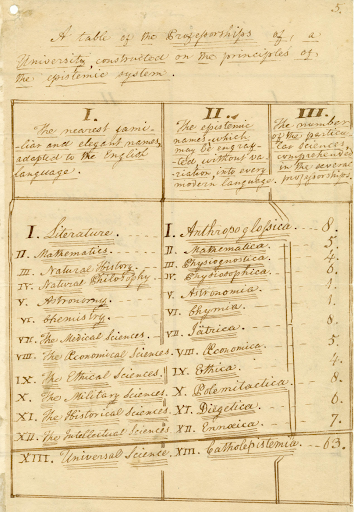
For its time and place, Woodward’s educational framework was expansive, providing engagement with a broad variety of fields, many of which remain part of the University of Michigan’s curriculum. His vision laid the foundation for the broad, multidisciplinary institution that we know today.
Beyond identifying courses of instruction, U-M’s early leaders envisaged the university as a dynamic institution, with learning taking place not just in classrooms but in a variety of settings. As outlined in “An act to establish the Catholepistemiad, or university of Michigania,” the institution should grow to include “colleges, academies, libraries, museums, athenaeums, botanic gardens, laboratories, and other useful literary and scientific institutions,” to the benefit of all the territory’s settlers. [5]
The University of Michigan’s contemporary scale—spanning a vast array of colleges, research institutes, libraries, museums, laboratories, and even botanic gardens—meets and far exceeds this capacious early vision, offering students, community members, and Michiganders a multitude of opportunities to learn and grow.

Education for whom?
But this is only part of the larger story of U-M’s founding. Approximately one month after the Catholepistemiad was established in Detroit, an event with momentous consequences for the nascent institution unfolded sixty miles south. On September 29, 1817, the Treaty of Fort Meigs (also known as the Treaty of the Maumee Rapids) was signed near Fort Meigs, Ohio. The treaty ceded millions of acres of Indigenous land in northwestern Ohio to the United States, but its sixteenth article dealt with the Michigan Territory, setting aside 1,920 acres of Anishinaabeg (Odawa, Ojibwe, Potawatomi) land for the “College at Detroit.”
Article 16: Some of the Ottawa, Chippewa, and Potawatomy tribes, being attached to the Catholic religion, and believing they may wish some of their children hereafter educated, do grant to the rector of the Catholic church of St. Anne of Detroit, for the use of the said church, and to the corporation of the college at Detroit, for the use of the said college, to be retained or sold, as the said rector and corporation may judge expedient, each, one half of three sections of land, to contain six hundred and forty acres, on the river Raisin, at a place called Macon and three sections of land not yet located, which tracts were reserved, for the use of the said Indians, by the treaty of Detroit, in one thousand eight hundred and seven; and the superintendent of Indian affairs, in the territory of Michigan, is authorized, on the part of the said Indians, to select the said tracts of land. [6]
With this generous act, some of Michigan’s Anishinaabeg people worked to forge a relationship of reciprocity with the university, seeing the land grant as an opportunity for their children and descendants to access an American-style education. Like Woodward and Richard, the Anishinaabeg signatories, too, had their own vision of what the university might look like. Learning English and other subjects, Anishinaabeg students would help their communities navigate intensifying pressure on their lands and resources. The precedent set by the Spring Hill School, attended by Potawatomi students and operated with help from a Potawatomi woman, showed a collaborative arrangement was possible.
Unfortunately, the university’s leaders did not share this vision, and little effort was made to recruit and enroll Anishinaabeg students. As far as is known, it took nearly 100 years before the first Anishinaabeg student took college-level classes at the university that was founded in part through a land grant from some of the Anishinaabe people of Michigan.
Statewide Reach
The university did, however, set in motion plans to educate more of Michigan’s settler population. As Michigan attained statehood in 1837, numerous branch campuses of the university were set up in emerging towns such as Pontiac, Kalamazoo, White Pigeon, and Romeo. [7] The branches served as preparatory schools, equipping primary- and secondary-level students for enrollment in the university itself, which opened in Ann Arbor in 1841. That same year, the branches at Detroit, Kalamazoo, White Pigeon, Tecumseh, and Ann Arbor enrolled 210 students, both boys and girls. [8] From its humble origins in a drafty two-story building in Detroit, the university had expanded its footprint, establishing a presence in many of Michigan’s settled counties and bringing education to a broader population.
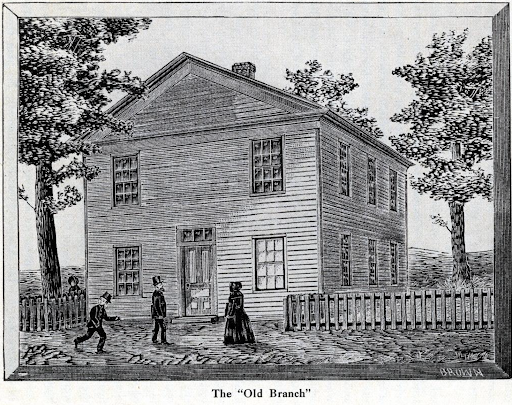
While the branch system was short-lived, it reflected a continuation of the institution’s broader ambition to extend education to multiple publics across the state. At the same time, the promise of Article 16 remained largely unfulfilled, with the university making little effort to enroll Anishinaabe students. From preparatory schools in emerging towns to research stations, medical facilities, and regional campuses today, the University of Michigan has continually extended learning and opportunity to a wider population, even as it continues to reckon with an imperfect history.
Past, Present, and Future
Grand as their vision was, U-M’s early leaders could not have foreseen the scale of the University of Michigan today. U-M’s campuses at Dearborn and Flint have played a pivotal role in expanding access to higher education across Michigan, yet their campuses have not always received comparable resources or public attention. Michigan Medicine and Athletics have become enduring university traditions and key vectors through which people engage with the institution, with each carrying its own history of inclusion and exclusion. Nor could U-M’s founders have imagined how the university would grow to serve multiple, diverse publics and expand its community. The inclusion of Native American, Black, Latino, Asian, first-generation, and other previously under-represented groups of students has not been seamless, marked at times by institutional inaction and even resistance, but also by resilience and achievement. U-M’s Inclusive History Project, a tri-campus presidential initiative launched in 2022, is working to deepen public understanding of these critical moments of institutional transformation. In so doing, we hope to reflect on our collective past and create the institutional self-knowledge and historical expertise necessary to shape a more inclusive present and future for U-M.
Looking back over 200 years to U-M’s founding, we see that experimentation, ambition, and a commitment to education and service have always been at the university’s core. That history and legacy encourage us to be bold and aspirational as we think about the campus of the future.
Notes
- Peter Audrain to Arthur St. Clair, November 1, 1798, in The St. Clair Papers vol. 2, ed. William Henry Smith (Cincinnati: Robert Clark & Co., 1882), 435.
- Clarence M. Burton, The City of Detroit, Michigan: 1701-1922 vol. 1 (Detroit-Chicago: S.J. Clarke Publishing Company, 1922), 705-721.
- Andrew Ten Brook, American State Universities: Their Origins and Progress; A History of Congressional University Land-Grants; A Particular Account of the Rise and Development of the University of Michigan (Cincinnati: Robert Clarke & Co., 1875), 86-105.
- Augustus B. Woodward, A table explaining the meaning of the names of the professorships mentioned in the act, Charles I. Walker Collection, 1817-1887, Bentley Historical Library, University of Michigan.
- An Act to establish the catholepistemiad, or university of Michigania, in Records of the University of Michigan, 1817-1837 (Ann Arbor: University of Michigan, 1935), 3-5.
- Treaty of Fort Meigs (or Treaty of the Maumee Rapids), September 29, 1817. National Archives and Records Administration.
- University of Michigan Regent’s Proceedings with Appendixes and Index, 1837-1864 (Ann Arbor: University of Michigan, 1915), 285.
- Ibid, 193.
This post was written by Jonathan Quint, Research Associate for the U-M Inclusive History Project (IHP). The IHP is a University of Michigan presidential initiative that researches and documents the university’s history to inform the creation of a more equitable and inclusive future.